Curious what sort of projects you’ll find in my forthcoming book, The Quilter’s Appliqué Workshop? Now you can see a preview on Google Books and Amazon
The Amazon preview
The book is due out in February, and you can preorder a copy from Amazon
Happy Halloween! As I mentioned on my Facebook page, I’m the delighted owner of a new Janome Horizon 8900 sewing machine, and I’ve been happily mucking about with all of its stitches, features, and capabilities.
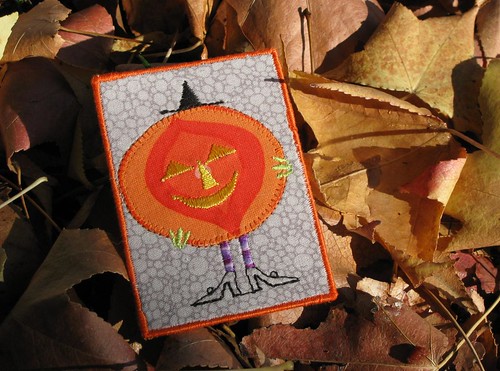
Straight stitching may be 99% of my (and many people’s) sewing, but I’m determined to put the hundreds of decorative stitches on this machine to use somehow. I never thought I’d have any use for the high-heeled shoe stitch (no. 264 on the 8900), but when I was sewing out a stitch sampler, it struck me that the shoes looked a bit like witchy boots, so that’s what they became when I worked up the little Halloween appliqué picture yesterday. And the fingers holding the pumpkin? They’re actually petals from partially sewn out flower stitches (no. 210). For a machine with no embroidery function, I’m pretty impressed!
Apparently I’ve had witch legs on the brain; one of my projects for the Fall 2013 issue of Stitch was a doorstop inspired by the wicked witch departed by Dorothy in The Wizard of Oz.
If I’d had the new machine when I made the doorstop, I could have sewn the buckles on by machine with the button-sewing function! I need to sew a button back onto a jacket, so that’s what I’ll be doing tonight between trick-or-treaters ringing the doorbell. So the spookiest thing happening for Halloween round here is that I’m getting excited about a mending job.
![]() |
| Paper Shredder Quilt pattern originally published in Stitch, 2011 |
![]() |
| Collage Newspaper Strips in Red by Carrie Bloomston of Such Designs for Windham Fabrics, 2013 |
I was looking for a way to dress up some wood needle cases, and suddenly it struck me—they’re shaped quite a bit like English pillar boxes! A couple coats of paint and a royal cypher later, they truly looked the part. I sent one to the Mother and kept another to hold my own appliqué needles.
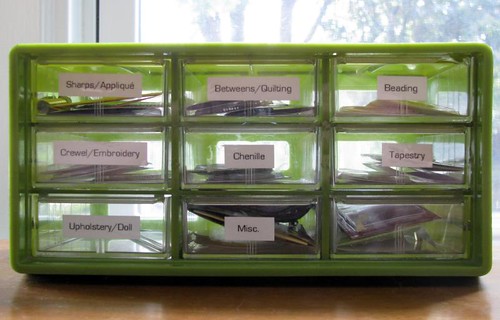
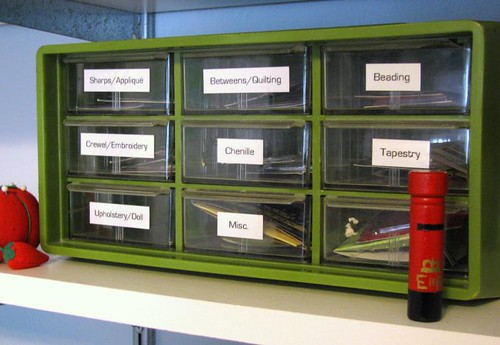
Of course, the post-box needle case is just a fun way to tote my most-used needles around. Coincidentally, I’ve also worked out how I want to store packs of hand needles, after much deliberation: an unassuming plastic drawer unit.
Prior to this little number, I stored needles based on purpose—embroidery needles with my embroidery floss, appliqué needles with my appliqué toolkit, betweens with my hand-quilting threads…. It sounds logical, but I often found myself digging around more than necessary to get at a needle: if I was doing a little embroidery with pearl cotton, I still had to get out all my stranded floss ’cause that’s where the needles were. If I wanted a tapestry needle, had I left them with needlepoint stuff, or were they in with the flosses too? And what about basic sharps and other miscellaneous needle types? I had packs of needles tucked in all kinds of places and never seemed able to find just want I needed, even though I knew I had it somewhere.
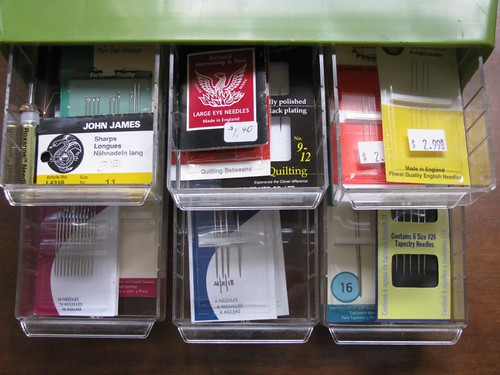
The drawers comfortably contain pretty much all the various forms needle packaging takes—hang cards, envelopes, tubes, folders, you name it. I labeled the drawers so I can still sort the needles by type, but now I have a central location for them all to live while waiting for active duty (at which point they take up residence in a needle book). Finding particular needles is much easier, and I can easily see what I have and what needs replenishing. Many of my organizing ideas don’t last very long in practice, but this is one I’ve been able to stick with.
How do you store your hand needles?
The Other (a professor of film studies) and I went to see Pasolini’s The Canterbury Tales (1972) in San Francisco yesterday, and it wasn’t the bawdy humor or nudity that shocked me: instead, I was stunned by the presence of patchwork and quilting throughout!
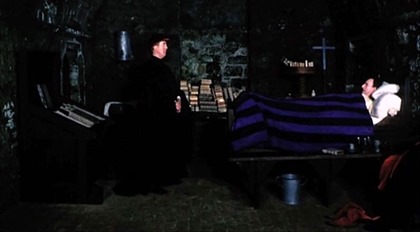
I made some screengrabs from Netflix when we got home, and I count at least 9 different patchwork quilts on various beds though the movie, with some of the quilts seeming to make multiple appearances. And I’m not even counting (or capping) the plain blankets that were quilted but not pieced.
This shot shows no less than 3 quilts keeping the pilgrims warm while they rest for the night. The camera pans around the hall, finally resting on Chaucer himself (played by Pasolini himself) next to yet another quilt, the (presumably) same isosceles triangle one as from my first cap above.
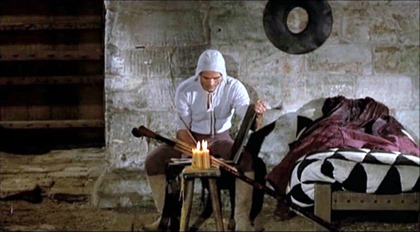
Not only were there quilts everywhere in the film, but I couldn’t help feeling like they were pretty similar to what we think of as modern quilts today: simple shapes, uncomplicated patterns, limited palettes….
It goes without saying that these quilts aren’t what would have been typical bedcoverings in late fourteenth-century England, so I think they’re meant to be more suggestions of the medieval milieu—similar geometric patterns pop up in other places, like the floor covering behind the Wife of Bath (the feet of her most recent victim/husband are on the bed quilt) as well as in the original movie poster.
Perhaps most interestingly, quilted banners appear in a formal court gathering, building heraldic images out of patchwork.
In comparison with these banners, the patterned bed quilts seem to me to be hinting at the pageantry of the middle ages—but I’m really not sure what to make of it all. It’s got me fascinated, though, and I’m going to see if I can figure out what Pasolini and art director Dante Ferretti were getting at with all this quilting and patchwork.
(These aren’t all the quilts in the movie; I had to limit the caps to the ones that were least rude! If you’ve read the original Canterbury Tales, you’ll have some idea of what I mean, though Pasolini does take certain things further…which can be both amusing and disturbing!)