Saturday, September 15, 2007
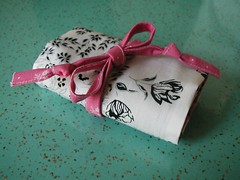
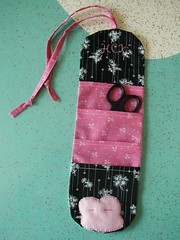
Happy birthday to the Mother!
The "sewing roll" pattern comes from here. I picked up the black-on-white fabric for the Mother in Berlin, and the pink and black fabrics came from the local quilt shop I've been delighted to find here in our crummy corner of California.
I just picked the colours 'cause I thought she'd think they were fun, but it turns out she's been working on some bigger bags in the same colours. The Father's always thought the Mother and I had a creepily direct link to each other's brains...
Happy birthday, The Mother! Lots of love from your Feed Dog.
Monday, September 10, 2007
If I weren't me, I'd be jealous of me
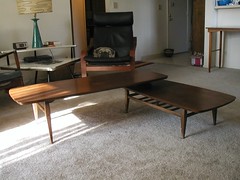
On a whim, the Other suggested we pop into a usually fruitless Goodwill yesterday. And look what we found! This saucy little coffee table is made of two pieces, joined with a peg, so that the lower surface can swing all the way around to make an L shape or a long table. Or it can be tucked underneath to save space and make a nice shelf for magazines and remote controls.
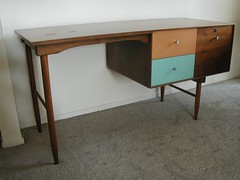
But that's not all! As we were rushing to get the table safely in our clutches, we spied one of the loveliest midcentury desks I've ever seen...
My apartment has always featured aqua and orange, so could it be more perfect? I'm criminally infatuated. The price tag left marks on the top, so I may need to refinish it, but the Other and I are already fighting over who gets to occupy the desk. Since I'm working from home now, it's obviously going to be me. (I shall have the most beautiful office/sewing room in all the land!) Felis Domesticus (that is, the Other's cat) has staked her own claim, basking on the desktop before the dust had even settled. She does know how to push my buttons—and she knows bloody well I can't spritz her with the water bottle if she's near delicate wood surfaces.
The cost for these two pieces? Less than $50 for the pair. (Plus taxi fare to haul the desk down the street—we looked ridiculous enough shuttling the table home on foot.) And both were pieces of furniture we kind of needed.
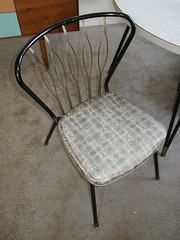
But that's still not all! The Other's had a set of dining chairs like this for a while:
Good, eh? I've always loved the pattern on the vinyl seats (click the photo for a closer look). Lo and behold, what did we find at an antique shop on Saturday?
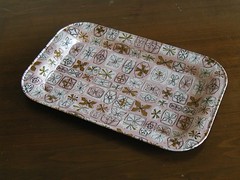
Same pattern! Different colours, but given the Other's appreciation of flamingos and the like, the pink was perfect. There was a pair of the trays, so naturally we took them both home. Anybody know anything about the pattern's provenance?
We're probably moving apartments soon, so things aren't quite settled, but we're getting there. And I'm delighted to have a partner in crime to salivate over bargainous furniture with. (Watch for edits to the previous sentence
Thursday, September 06, 2007
EQ6 Workaround: Save Appliqué or Piecing Templates
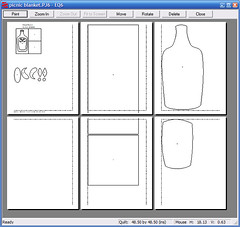
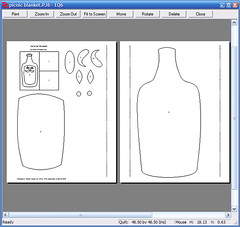
The background for this block I designed for a picnic blanket is pieced; I can rotary cut the rectangles, so I don't need templates for them. I got rid of them and nudged the other pieces around until everything fit on two pages (EQ6 still showed a third blank page, but it doesn't print the blanks):
So far so good. But to print the templates again, I'd have to start with the original layout. EQ6 doesn't offer a way to save templates, but here's a workaround to do just that. As an added benefit, your templates will be universally accessible, even to people who don’t have EQ. Really, it's just printing a PDF.
-
Make sure your computer has a PDF printer driver installed. I use CutePDF. Macs usually let you save a PDF directly from the print dialogue, but if you had a Mac, you wouldn’t be using EQ6, would you? (That is, unless you were some kind of Parallels wizard.)
-
Tell EQ6 to print your templates (File | Print | Templates). Double check that the settings (line width, key block, etc.) are how you want them.
-
Click the Page Setup button, then click the Printer button. Choose the PDF printer.
-
Back on the Print Template screen, press the Preview button. Arrange your templates how you like, rotating, moving, and deleting patches as necessary (click the buttons along the top, then click the patch you want to change. For deleting, you’ll need to press the Delete key on the keyboard when the patch is highlighted). Make sure to leave an adequate margin around the edge of the page—the PDF might fit everything fine, but the printer it ultimately sends to may not.
-
Press Print. When the PDF driver prompts for a file name, choose a folder, name the file, and hit OK.
-
When you print templates from the PDF, make sure the pages print at 100%—that is, without any page scaling. Adobe Reader often defaults to scale everything down to the printer margins, but you don’t want that here. There’s a drop-down on the Print dialog box to set it right.
These templates are all set for e-mailing to a friend, taking to the copy shop, or whatever.
EQ6 does have some frustrations, but it certainly makes quilting easier. Give it a go...
Friday, August 31, 2007
Youngest Brother reveals freakish grasp of fabric industry
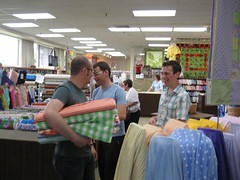
The wedding brought nearly every relation I have out of the woodwork (one wonders what was left of the woodwork, in fact), but more relevant to the topic at hand was the Mother and I dragging Middle and Youngest Brother to a quilt shop while waiting for the Other's plane. It was a pretty good shop, with 15% off their vast array of cottons.
While I stacked bolts under my arm, Youngest Brother proved that I am not the only male in the family to have developed an appreciation of fabric. The Mother was on the hunt for pre-Civil War reproduction prints, a new territory for her, and Youngest Brother spotted one he thought she would like. “It looks like the Jane Austen Collection,” he suggested, and the Mother and I burst into laughter at the thought that he was even aware of there being specific fabric lines, much less that he could name one, much less that he could aesthetically categorize a stray fat quarter. We unfurled the chunk to discover that, yes, in fact, he had accurately identified the fabric. We were stunned. As one of the Mother’s quilting buddies said about my appliqué stitches, it must be genetic.
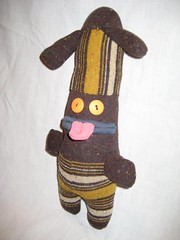
But he's not just watching the needle arts from afar. I've mentioned Youngest Brother's sock creatures before, and he e-mailed while we were in Berlin to say he'd made this one for me. Rather impressive, eh? I especially like the stripes, oblong head, and dangly ear things.
However, the promised creature has yet to arrive. Where be it, boy? I mean, you've only just started college, and I can't imagine what could be more pressing than shipping it off to yours truly.
Monday, August 06, 2007
Fichu: if you want it, he's got it
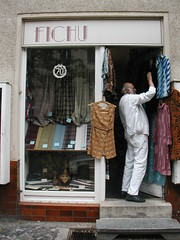
The other day I reaped the rewards of fabric tourism as the Other’s friend Lydia introduced me to Fichu, which she claimed was the best fabric shop in Berlin. It's not only that; it's like a parallel universe where no fabric ever dies—floor to ceiling stacks of vintage fabric from any period you could imagine, many still on the bolt and available in whatever amount you need. (And in this parallel universe, there must not be fire marshals.) A cotton avalanche seemed imminent and in place of aisles there were a couple paths carved through the stacks, so browsing was a little tricky. Instead, you just had to let the shopkeeper know what you were looking for, and chances are he could unearth it from whatever magic rabbit hole he had at the back of the shop.
He was what really made the stop worthwhile. He’s been selling textiles for many moons, and seemed to know just about everything about them (the Berlin office of Christie’s uses him as an expert). I thought I was being clever by asking of a large-scale Finnish print was Marimekko—“Everyone knows only Marimekko,” he sighed somewhat jokingly. Keep thy cleverness to thyself, Feed Dog.
I was of course mostly looking for midcentury fabric; he noted that it’s almost always people from English-speaking countries who are looking for retro prints. Australians in particular, he said; their population didn’t boom until the Fifties, so they don’t have much native midcentury design. Germans, he said, like Op-Art and Seventies design theoretically, but “for someone else” rather than in their own homes.
It was a shame I wasn’t looking for anything in particular, because I’m sure it would have been there. I ended up buying half a metre of two fabrics—an indulgence, but worth it for the experience, which was more like visiting a museum than shopping.
Update: Here's the fabric I bought (click to zoom).
I'm not entirely sure what I'm going to do with them, but I'm sure I'll come up with something.